
Article reviewed by:
Dr Soh Shean Han • Orthodontist

As parents, you want your children to grow up healthy and confident, including having a smile they feel good about. Many people associate orthodontics with teenagers in braces, but early evaluation can play a crucial role in supporting healthy tooth and jaw development. Research shows that timely orthodontic treatment can significantly improve misaligned teeth and bite issues (e.g underbite, protruding teeth). Acting early can also reduce subsequent treatment complexity, and improve long-term oral health for your child.
Table of Contents
What is early orthodontic intervention?
Early orthodontic intervention focuses on assessing and addressing dental and jaw development issues in children, usually between ages 7 and 10. At this stage, children have a mix of baby (primary) and adult (permanent) teeth, making it easier for orthodontists to guide jaw growth and correct alignment problems before they become more severe.
Early intervention can:
- Guide jaw growth
- Correct bite problems (overbite, underbite, crossbite)
- Create space for crowded teeth
- Reduce the complexity of subsequent orthodontic treatment
Signs your child may need early orthodontic assessment
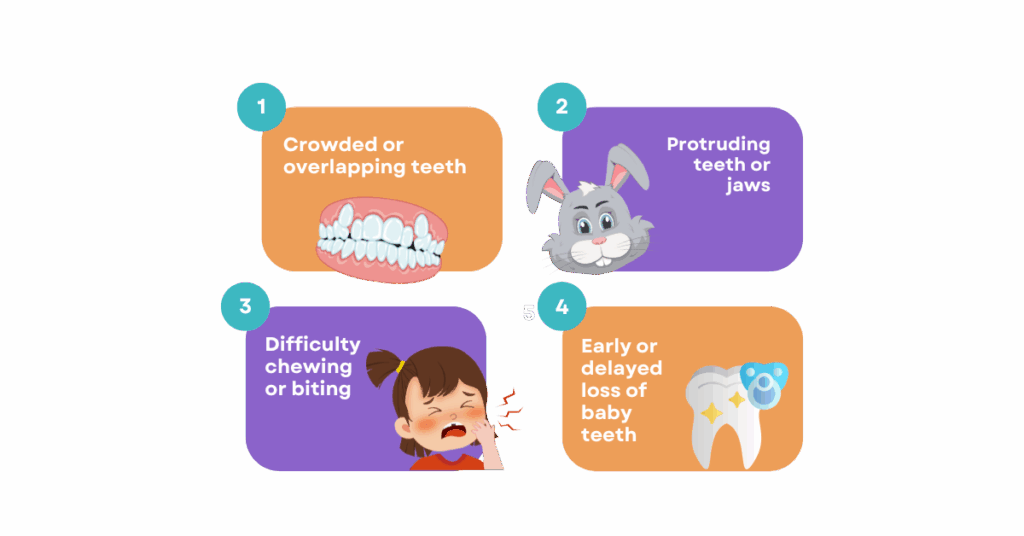
Knowing when a child needs orthodontic intervention isn’t always straightforward. Development issues can be present even if a child’s teeth appear to be straight. Parents should consider consulting an orthodontist if they notice:
- Crowded or overlapping teeth
- Spacing
- Protruding teeth
- Underbite or crossbite (lower front or back teeth biting beyond upper teeth)
- Deep bite (increased vertical overlap between upper and lower front teeth)
- Open bite (teeth do not meet)
- Early or late loss of baby teeth
- Delayed emergence of adult teeth
- Jaw malalignment
- Difficulty chewing or biting
Even if issues appear minor, an orthodontic assessment can detect hidden problems and intervene before they worsen.
Possible benefits of early intervention

- Reduces the need for extensive treatment later
Addressing alignment or jaw issues early often means children require shorter or simpler braces treatment during adolescence. - Supports proper jaw growth
Guiding jaw development early maximizes the potential of growth to correct issues with the child’s bite. This can lead to simpler treatment in adolescence with lower risk of complications such as gum shrinkage (gingival recession). It can also result in a more functional, aesthetic and stable overall treatment outcome. - Prevents dental complications
Misaligned teeth can be harder to clean, increasing the risk of cavities and gum disease. Early correction can help maintain long-term oral health in these cases. - Boosts confidence and self-esteem
Improved alignment can help children feel more confident about their appearance.
When should your child see an orthodontist?
The American Association of Orthodontists recommends that children have their first orthodontic check-up by age 7. At this age, most children will have a mix of baby and adult teeth, allowing an orthodontist to identify developing problems and intervene if needed.
Potential outcomes of an orthodontic consult
- No treatment
- Regular monitoring – to prevent existing issues from worsening
- Early intervention
Treatment is not always needed immediately.
Some common early orthodontic treatment appliances
- Palatal Expanders: A dental appliance designed to expand the upper jaw (maxilla), making room for emerging teeth, correcting crossbites, and improving overall bite alignment.
- Clear aligners or Partial braces: localized correction of misaligned adult teeth.
- Space Maintainers: Hold spaces for adult teeth to grow when there is early loss of baby teeth.
For more information on orthodontic treatments, refer to our Comprehensive Guide to Clear Aligners and Comprehensive Guide to Braces in Singapore.
Final thoughts
Addressing orthodontic needs early goes beyond straightening teeth for aesthetics. It can also support your child’s jaw development, bite function, long-term oral health and confidence. Detecting potential problems early allows orthodontists to guide proper jaw and tooth development, which may prevent more invasive and costly treatments in the future.
If you’re unsure whether your child needs an assessment, scheduling an early orthodontic consultation by age 7 is the first step toward a healthy, confident smile.
Think your child might need an orthodontic assessment?
Book a consultation with our orthodontist today and give their smile a head start.

Reviewed by Dr Soh Shean Han
Dr Soh Shean Han is an Orthodontist with Specialist Dental Group®. She received her specialty training in Orthodontics from University of Washington-Health Sciences School of Dentistry, USA. She is an Adjunct Senior Lecturer with National University of Singapore and Associate Staff at National University Centre for Oral Health, Singapore. Dr Soh provides orthodontic treatment across all ages, including young kids and adults. She has a special interest in clear aligner treatment and the management of jaw deformities.
Disclaimer
This article has been medically reviewed by a specialist from Specialist Dental Group and is intended for general educational and informational purposes only. It should not be taken as a substitute for personalised dental advice, diagnosis, or treatment. Patients should consult a qualified dentist or dental specialist before making decisions about any procedure or treatment plan. Treatment recommendations should always be based on the patient’s individual clinical condition, and results may vary.