
文章审核人:
苏显涵医生 • 正畸医生
快速回答
Yes, you can get braces after 30, 40 or even 50. There is no specific upper age limit for orthodontic treatment, provided your teeth, gums and supporting bone are suitable.
What makes adult orthodontic treatment different is not simply age. Adults may have existing crowns, dental implants, missing teeth or changes in gum health that need to be considered before moving their teeth.
An orthodontist assesses these factors alongside your bite and treatment goals to determine whether braces or clear aligners are suitable, and how treatment can be planned around your existing dental condition.
关键精华
- Age alone does not determine whether you can have braces. Your oral health and orthodontic needs matter too.
- Healthy gums and supporting bone are important. Active gum disease should be treated and stabilised before orthodontic treatment.
- Existing dental work may affect treatment planning. Crowns, bridges and dental implants need to be considered.
- Treatment duration depends on the individual case. Being over 30 does not automatically mean wearing braces for longer.
- Both braces and clear aligners may be suitable for adults. The appropriate option depends on the movements required.
- Retainers are important after treatment. Teeth can continue to shift throughout adulthood.
目录
If you are over 30 and considering 背带, you may have wondered whether you have left it too late.
Perhaps your teeth have become more crowded over the years. Maybe you had braces when you were younger, but your teeth have gradually shifted again. Or perhaps straightening your teeth was something you never got around to doing.
好消息是, 正畸治疗 remains an option for many adults. However, the approach may be different from during your teenage years.
Here is what you should know before deciding whether to get braces as an adult.
How Is Adult Orthodontic Treatment Different from Teenage Braces?
The main difference is not simply how old you are. It is the condition of your teeth, gums, supporting bone and bite. When treating younger patients, orthodontists take into account how their jaws and teeth are still developing.
In adults, jaw growth is generally complete, so certain bite or jaw discrepancies may require a different treatment approach. Some adults may have dental concerns that need to be managed alongside their orthodontic treatment.
Here are some important factors your orthodontist will consider.
1. Gum Health and Bone Support Are Particularly Important
Before moving your teeth, an orthodontist needs to assess the health of the gums and bone supporting them. This is important at every age, but particularly relevant for adults who may have experienced gum disease or bone loss over the years.
新加坡2019年全国成人口腔健康调查 报道 that 56.9% of surveyed adults had moderate-to-severe chronic periodontitis, with prevalence increasing with age. Periodontitis is a form of gum disease that can damage the tissues and bone supporting the teeth. If you have bleeding gums, gum recession, loose teeth or a history of periodontal disease, these concerns should be assessed before starting braces.
Is Orthodontic Treatment Possible If You Have Gum Problems?
Having a history of gum disease does not automatically rule out orthodontic treatment.
However, active periodontal disease generally needs to be treated and stabilised first. Depending on the condition of your gums and supporting bone, your orthodontist may work with a 牙周病 (gum specialist) to plan and monitor treatment.
2. Adult Teeth Can Still Move, but Treatment Needs Careful Planning
A common concern is whether teeth become too difficult to move after 30. They do not.
Orthodontic treatment works by applying controlled forces that allow the bone surrounding the teeth to remodel. This process continues throughout adulthood. However, adults may have changes in bone support, tooth wear or other dental conditions that influence treatment planning.
Does Orthodontic Treatment Take Longer For Adults?
Not necessarily. Treatment duration depends on factors such as:
- The severity of crowding or bite problem
- The amount and type of tooth movement required
- The health of your teeth and supporting tissues
- Patient’s compliance with treatment instructions
Some adult cases are relatively straightforward, while others require more extensive treatment. Your orthodontist can provide a more meaningful estimate after an in-person examination of your teeth and bite.
3. Existing Crowns, Bridges and Dental Implants May Affect Treatment
By adulthood, you may already have undergone dental treatment such as fillings, crowns, bridges, root canal treatment or dental implants. These do not necessarily prevent you from getting braces, but they need to be considered when planning tooth movement.
For example, an adult with crowded teeth may also have a dental implant replacing a missing tooth. Unlike natural teeth, the implant cannot be moved with braces. The orthodontist therefore needs to plan how the surrounding natural teeth can be repositioned while accounting for the fixed implant.
Other dental conditions that may influence orthodontic treatment include:
- 冠: Teeth with crowns may still be moved orthodontically, although attaching brackets may require additional consideration.
- 吊桥: Teeth connected by a bridge may require special planning because they cannot always be moved independently.
- Missing teeth: Orthodontic treatment may sometimes be used to close gaps or create appropriate space for future tooth replacement.
This is why two adults with seemingly similar crooked teeth may require very different treatment plans.
When several dental issues need to be addressed, orthodontic treatment may be coordinated with other dental specialists. For instance, an orthodontist and 修复医生 may work together to plan tooth positioning before a crown, bridge or implant restoration.
At Specialist Dental Group, specialists from different dental disciplines practise together under one roof. For adults who need more than one type of specialist care, this makes it more convenient to receive coordinated treatment without having to visit different clinics.
4. Correcting Your Bite and Jaw Discrepancy May Be Just as Important as Straightening Your Teeth
You may be considering braces because your front teeth look crowded or uneven. However, an orthodontist also examines how your upper and lower teeth meet when you bite.
Depending on your needs, orthodontic treatment may address:
- 拥挤
- 间距
- 覆
- Underbite (lower front teeth sit ahead of the upper front teeth)
- Posterior crossbite (when one or more upper back teeth bite inside the corresponding lower teeth)
- 深覆合(上下前牙垂直重叠增加)
- 开颌(牙齿无法咬合)
Depending on the nature and severity of the bite problem, braces may not be sufficient to achieve the desired correction. In adults with significant jaw discrepancies, other treatment approaches, including 颌骨手术可能需要考虑。
The aim is to improve tooth alignment and, where appropriate, the way the teeth function together.
5. Previous Braces May Influence Your New Treatment Plan
Have you noticed your teeth becoming crooked again, even though you had them straightened years ago? This is not unusual.
Teeth can change position throughout life, particularly if retainers are not worn as advised after orthodontic treatment. However, changes in tooth position are not always due to stopping retainer use. Natural ageing, gum disease and other factors e.g. habits may also contribute.
If you are considering braces for a second time, your orthodontist will assess and determine how your bite has changed over time. Some patients may only need limited tooth movement of selected teeth. Others may require comprehensive treatment involving all their teeth if their bite or dental condition has changed.
What Types of Braces Are Suitable for Adults Over 30?
Adults have several orthodontic treatment options. The most suitable choice depends on the complexity of the case, the tooth movements required and one’s personal preferences.
| 治疗选择 | 要知道些什么 |
| 金属牙套 | Fixed metal brackets and wires that can treat a wide range of alignment and bite problems. |
| 陶瓷牙套 | Similar to metal braces, but use tooth-coloured brackets that are less noticeable. |
| 透明矫正器 | Transparent, removable trays that gradually move teeth according to a pre-planned sequence. |
Clear aligners may appeal to adults who prefer a less noticeable appliance, particularly in professional or social settings. However, they require consistent wear of around 20–22 hours daily, and require removal before consumption of food and beverages.
Your orthodontist can explain the advantages and limitations of each option based on your individual needs.
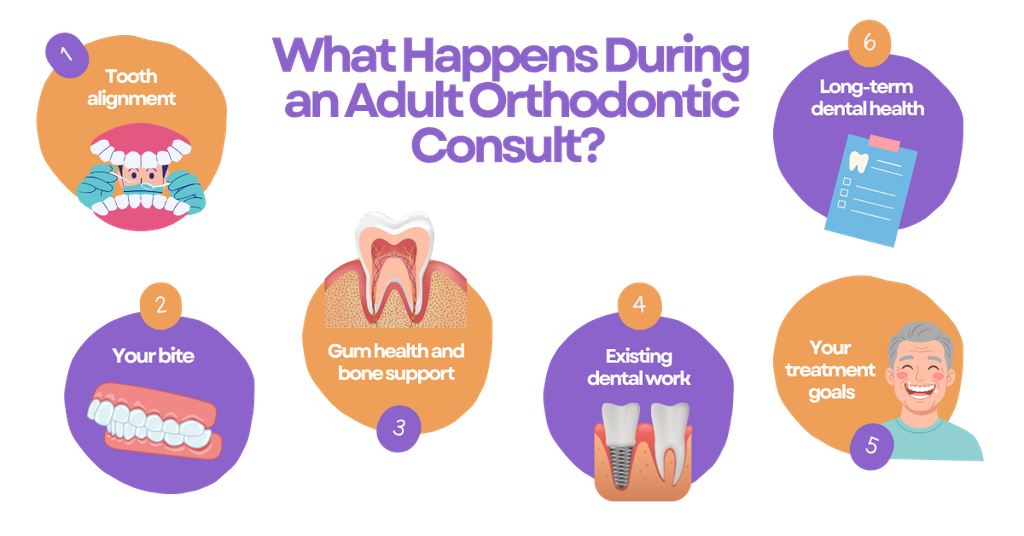
What Happens During an Adult Orthodontic Consultation?
If you have been considering braces for some time, your first consultation is an opportunity to understand your options before deciding whether to proceed.
Your orthodontist will examine your teeth, gums and bite, review any existing dental work and discuss what you hope to achieve.
For some adults, treatment may be relatively straightforward. Others may have concerns such as jaw discrepancy, gum disease, missing teeth or existing implants that require additional planning.
Depending on your dental condition, further investigations or assessments by other dental specialists may be recommended.
The consultation should help you understand:
- Whether orthodontic treatment is suitable for you
- What braces or clear aligners may be able to achieve
- Whether any dental concerns need to be addressed first
- The possible treatment approaches, limitations and expected duration
The aim is to help you make an informed decision based on your individual dental needs, rather than simply choosing between braces and clear aligners.
You can also use the consultation to discuss practical concerns, such as how treatment may affect your daily routine, oral hygiene and long-term maintenance.
Considering Braces as an Adult?
If you have been thinking about straightening your teeth but feel that you should have done it years ago, it is still worth exploring your options.
An orthodontic assessment can help determine the options available for your specific needs and the outcomes that you can realistically expect.
常見問題解答
No. There is no specific upper age limit for orthodontic treatment. Adults in their 40s, 50s and beyond may still be suitable for braces or clear aligners, depending on the health of their teeth, gums and supporting bone. An orthodontic assessment can help determine the appropriate treatment options.
Yes, with limitations in some cases. Unlike natural teeth, dental implants cannot be moved using conventional orthodontic forces. However, the surrounding natural teeth may still be repositioned. Your orthodontist will need to consider the position of existing implants when planning treatment.
Yes, depending on the cause of the sensitivity. Sensitive teeth do not automatically prevent orthodontic treatment, but underlying problems such as tooth decay, gum recession or enamel wear should be assessed first.
Braces cannot replace lost tooth structure. However, orthodontic treatment may improve tooth positioning and bite relationships. In some cases, restorative treatment may also be needed to repair worn teeth.
Yes, if the uneven appearance is caused by tooth movement or alignment problems that can be corrected orthodontically. If grinding habit (bruxism) or other dental conditions are responsible, additional treatment may be needed.
Not necessarily. Treatment time depends on the complexity of tooth movements, bite correction needed, patient’s oral health and compliance with treatment instructions. Some adult cases are relatively straightforward, while others require more extensive planning.
Possibly. Gum recession does not automatically prevent orthodontic treatment. However, the orthodontist needs to assess gum health and supporting bone before treatment. Some patients may require periodontal treatment or monitoring to reduce the risk of further problems.
Both can be effective, depending on the tooth movements and bite correction required. Clear aligners are removable and less noticeable, while fixed braces may offer advantages for certain complex movements. An orthodontic assessment can help determine the most suitable option.
Braces and clear aligners are usually considered elective procedures and hence ineligible for MediSave withdrawals or Community Health Assist Scheme (CHAS) support. Some insurance policies provide coverage for orthodontic treatment, especially those requiring functional correction of the teeth and/or jaw. Do check with your insurance provider for clarification. If required by your insurance company, we can assist with providing a memo after the in-person consult.
Treatment fees can vary depending on the complexity and duration of treatment, appliances used, and desired treatment objectives. The actual fee may be lower than the generic range quoted over the phone. An in-person examination and consult with our orthodontist will help in determining the treatment fee specific to your case.
Thinking about straightening your teeth?
Whether you are considering braces for the first time or your teeth have shifted after previous treatment, a consultation with our orthodontist can help you understand your options and make an informed decision.
Contact Specialist Dental Group via the WhatsApp icon on the bottom right corner – enquire or call us at (65) 6734 9393 to arrange an appointment.
由苏善汉博士审阅
苏显涵医生 is an Orthodontist with Specialist Dental Group®. She received her speciality training in Orthodontics from the University of Washington School of Dentistry, USA. She is an Adjunct Senior Lecturer with National University of Singapore and Associate Staff at National University Centre for Oral Health, Singapore. Dr Soh provides orthodontic care for children, teenages and adults, with special interest in clear aligner treatment and the management of jaw deformities.
免责声明
本文已由专科牙科集团的专家进行医学审核,仅供一般教育和信息参考之用。本文内容不应替代个性化的牙科建议、诊断或治疗。患者在决定任何治疗方案或程序之前,应咨询合格的牙医或牙科专家。治疗建议应始终基于患者的个体临床状况,治疗效果可能因人而异。